Demorest, Georgia: Hometown of the “Big Cat”
In June 2013, while on a road trip around the United States, I visited Demorest, Georgia, a small city with a population of less than 2,000.
Johnny Mize (who died in 1993 at age 80), one of the greatest players in Major League Baseball history, was born and raised in Demorest. He studied at Piedmont College in Demorest, where he devoted himself to baseball and became a major leaguer. Piedmont College houses the “Johnny Mize Athletic Center”, a memorial to him.
Johnny Mize played in the Major Leagues from 1936 to 1953, playing for three teams during that time: the St. Louis Cardinals, the New York Giants (now the San Francisco Giants), and the New York Yankees. During his prime, he missed three years of playing time due to military service during World War II, but during his 15 years as a player he achieved impressive results, winning the batting average title once, the home run title four times, and the RBI title three times. His career batting average of .312 is also impressive. He was also inducted into the National Baseball Hall of Fame.
When I arrived in Demorest, I got lost. Despite being a small city, it seemed to be a major transportation hub, with many impressive roads intersecting in a rather complicated manner. “This is bad,” I thought, panicking and decided to run into a gas station to ask.
When I asked a young white man at the gas station how to get to Piedmont College, he grinned and said,
“Where are you from?”
“From Japan.”
“I see, so it's no wonder you didn't know where it was.”
The man continued, pointing to the road in front of the gas station.
“Piedmont College is just a few minutes down that road. By the way, what do you want there?”
“I'm a huge Major League Baseball fan, and I wanted to see Johnny Mize's alma mater.”
“Wow. I'm so happy that you made the effort to come all the way to our town for that reason. Is Johnny Mize famous in Japan?”
“No, unfortunately he's not that famous, I don't know why.”
I honestly don't know why Johnny Mize is so unknown in Japan; I don't think anyone would know him unless they're a big fan of Major League Baseball
I arrived at a beautiful university surrounded by greenery that was enough to make me envious. At the same time, I was amazed and overwhelmed. Even though Piedmont College isn't specifically an athletics university, it boasts a total of three baseball fields: one spacious, full-scale baseball field (with luxurious spectator seating behind the backstop and even an electronic scoreboard at the back of center field), one spacious, full-scale softball field (which also has an electronic scoreboard at the back of center field), and one full-scale soccer field. It was truly breathtaking.

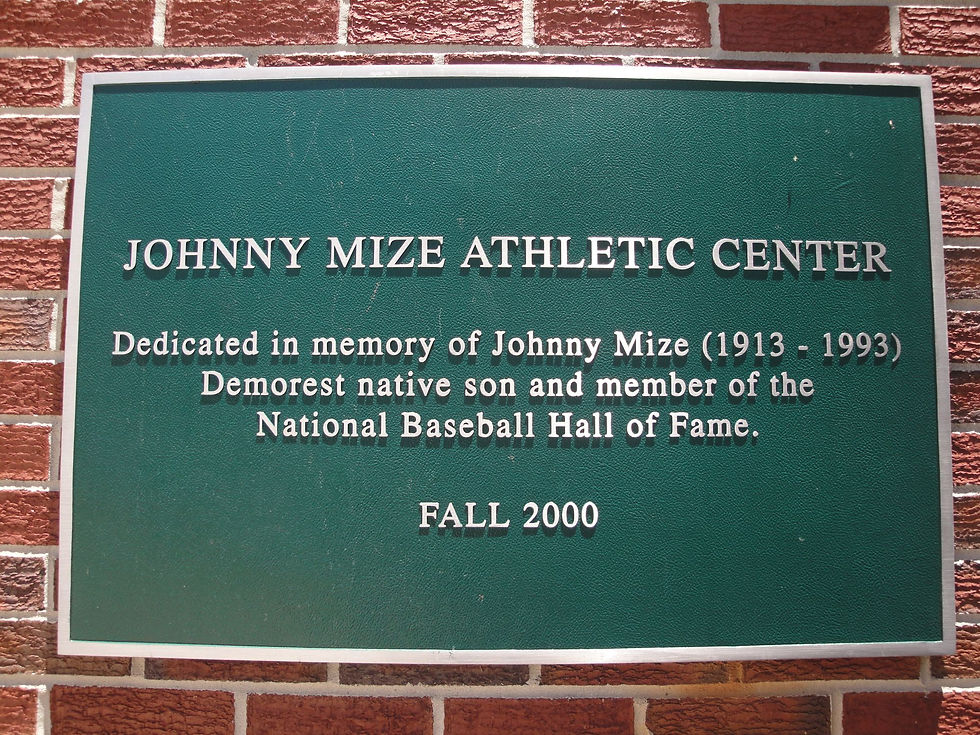
The “Johnny Mize Athletic Center” was a beautiful, single-story building. There was a plaque on the wall near the entrance that read, “Erected in the fall of 2000 in memory of Demorest native and Baseball Hall of Famer Johnny Mize.”
As I opened the entrance door and entered, my eyes were drawn to a large sign in the window of the cafeteria at the back of the spacious lobby. The sign had Johnny Mize's famous nickname, “BIG CAT,” emblazoned in large letters. It was a reminder of first baseman Johnny Mize's agile fielding, almost like a cat.

A side note: when I said to a Japanese friend who claims to be a Major League Baseball expert, “Johnny Mize's defense was superb, wasn't it?” my friend looked at me skeptically and said something really ridiculous: “That can't be true, because Johnny Mize never won a Gold Glove Award.” The Gold Glove Award was established in 1957, four years after Johnny Mize retired. If the Gold Glove Award had existed when Johnny Mize was still playing, he would have won it multiple times. This is a good example of how ignorant history can lead to some pretty ridiculous mistakes.
The spacious lobby of the “Johnny Mize Athletic Center” also serves as the “Johnny Mize Museum”. But as I entered the lobby, I thought, “Huh? Something's strange.” There was no one there. There was no one in the cafeteria, either—staff or customers. It was eerily quiet. Come to think of it, the entire university campus was deserted, too. “What on earth is going on?” I wondered, but after thinking about it for a while, I realized the reason: it was already summer vacation. I had completely forgotten that, unlike in Japan, universities in the United States begin their summer vacation after mid-June. But still, was it really okay to be so careless? Aren't they worried about someone sneaking in and stealing the baseball equipment and photographs used by Johnny Mize that are on display in the museum? Well, I'm not that kind of guy, so I decided to take a good look around.
As I began to look at the exhibits, a middle-aged white man suddenly appeared, so I tried to call out to him, but although he must have been aware of my presence, he completely ignored me and walked past me at an incredible speed as if he were taking part in a racewalking, and disappeared somewhere. I was surprised, but then I thought, “If that man doesn't seem to mind my presence, then I guess it's okay for me to look around this building as I please,” and so I did.
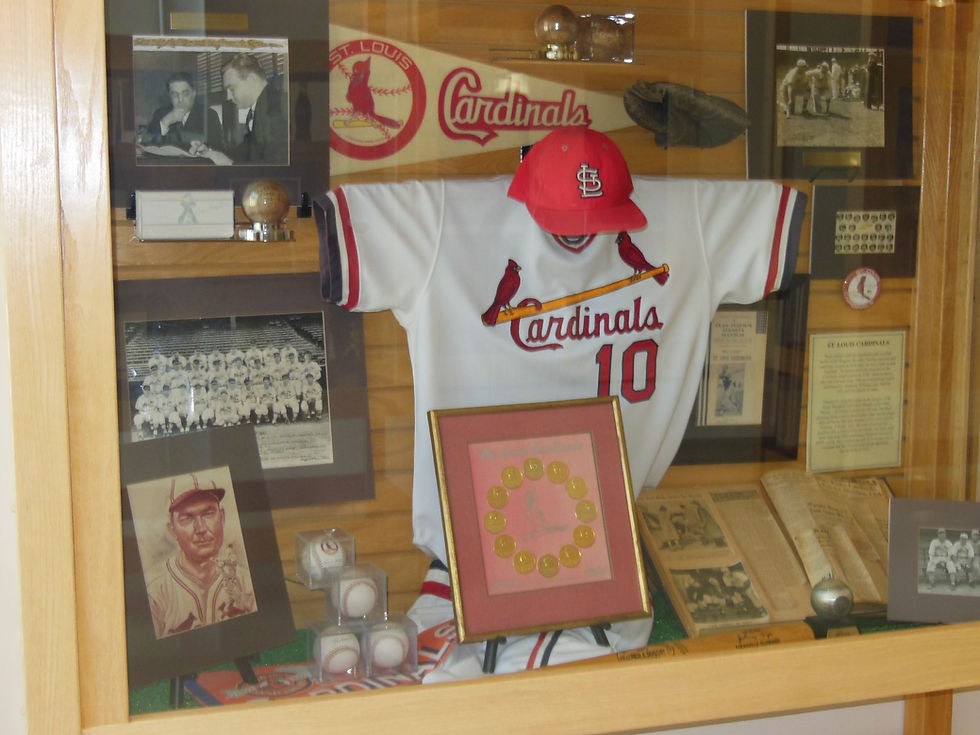
First, I took my time looking at the exhibits in the “Johnny Mize Museum”. There was an impressive display shelf for each of the three teams Johnny Mize played for, and each one was filled with photographs, newspaper articles, uniforms, gloves, and other items documenting Johnny Mize's achievements. Looking through them in order, I got a really good understanding of Johnny Mize's career as a major leaguer. This was possible because the display method was excellent.


In addition to the museum, the center also housed a magnificent basketball arena (so impressive it could easily host NBA games!), many office-like rooms, and a gym equipped with luxurious equipment.
I was amazed and envious that even a university in a small city in the United States could have such excellent facilities.
Another thing I envy is that a museum commemorating the major leaguer is located at the university he graduated from. I’m not aware of any examples in Japan of a museum commemorating a professional baseball player being located at the player’s alma mater. I suspect there are no such examples at all. It even seems as if Japanese universities don't feel the need to openly pay tribute to any professional baseball player.
( If I’ve made a mistake or left out something important, please let me know. I’ll try to make corrections or additions.)