Natchitoches, Louisiana : The man who created a new tradition
In the summer of 2016, I was driving east on I-10 (Interstate 10) near the Gulf of Mexico (now the Gulf of America) across the vast state of Texas.
As I finally left Texas and entered the neighboring state of Louisiana, I suddenly had a thought. “That’s a good opportunity to visit the Louisiana Sports Hall of Fame. I’m sure there will be an exhibit about the man who created a new tradition. It’s strange that I haven’t tried to visit it before.” So, in the middle of I-10, I got on I-49 and started heading north toward the inland. And I arrived in the city of Natchitoches.
It is a city of just under 20,000 people. After driving through the campus of Northwestern State University, I came out into the quaint and stylish old town. I drove slowly to the edge of the old town, admiring the large American flags that many of the stores on both sides of the main street were flying.
I was a bit surprised when I saw the Louisiana Sports Hall of Fame & Northwest Louisiana History Museum at the edge of the old town. It was a modern building, completely different from the atmosphere of the old town. But after looking at it for a while, I started to think, “It might be pretty cool to have a building like this at the edge of the old town.”
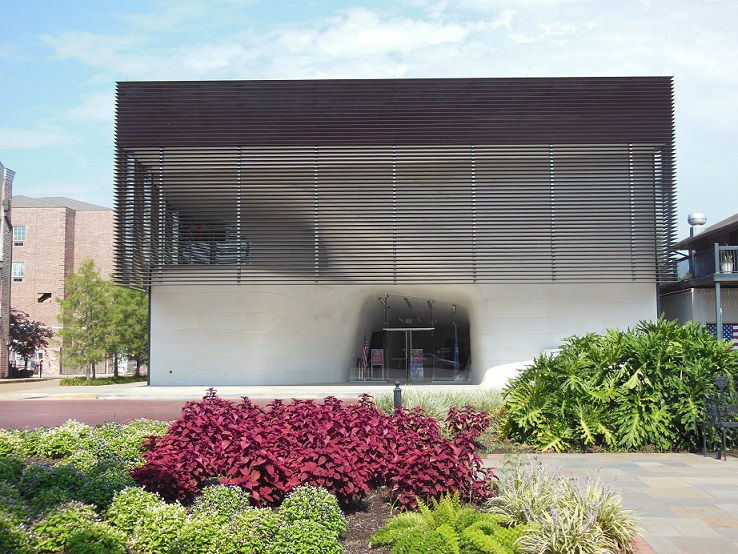
I paid $5.15 to get into the museum.
I first asked the white lady at the reception desk,
"How do you pronounce the name of this city?"
"It's Nackatish."
"Nackatish?"
"No. it's Nackatish."
Come on, I mean, it's Nackatish, right? Is this lady trying to make fun of me? No way a receptionist would do something like that. I asked again,
"Could you please pronounce it more slowly?"
"Nack-atish."
"Nack-atish?"
"Yes."
"Okay, could you please pronounce it normally again?"
"Nackatish."
"Nackatish?"
"No. it’s Nackatish."
"……Never mind, I get it. I guess it just means I have problems with my English hearing and pronunciation."
The museum was awfully quiet. Even though it was summer tourist season, there were only a few visitors.
On the first floor, there were displays of Hall of Fame inductees from various sports and the years they were inducted, as well as an exhibition of some Louisiana team sports.
The main exhibition area was on the second floor. There were exhibits of various sports: golf, American football, basketball, boxing, winter sports, tennis, horse racing, hunting...
At the very back, there was also an exhibition about the history of northwest Louisiana. This building is not only a sports hall of fame, but also a museum of northwest Louisiana history.
There was a section on baseball. Newspaper articles, uniforms, and bats were displayed in glass-covered display cases. Of course, there were also brief biographies and photographs of famous players from Louisiana. For example, Mel Ott (died in 1958 at the age of 49), a great player with 511 home runs in his career. For example, Lou Brock (died in 2020 at the age of 81), a great player with 3,023 career hits and the title of stolen base leader 8 times. For example, Albert Belle( now 59 years old ), a great player who was the home run leader once and the RBI leader three times, and is the fourth player in history to achieve the feat of hitting 30 home runs and 100 RBIs for eight consecutive seasons.

There were no displays of active major leaguers, but that didn’t bother me. It was enough because there was an exhibition of the important man.
Ron Guidry. A great pitcher who played for the New York Yankees in the 1970s and 1980s. His performance in 1978 in particular was so amazing that it could be said that he will go down in baseball history. He won 25 games, earning the titles of most wins and best ERA. He also won the Cy Young Award. Guidry’s uniform number 49 has been retired by the Yankees.

By the way, I learned something for the first time when I read “Memories of Yankee Stadium”(2008) by Scott Pitoniak, a famous American journalist. It is about Guidry, who started in a game on June 17, 1978. In that game, Ron Guidry set a team record with 18 strikeouts and led the team to a 4-0 victory. The Yankee Stadium tradition of fans clapping when a Yankees pitcher gets two strikes began with this game.
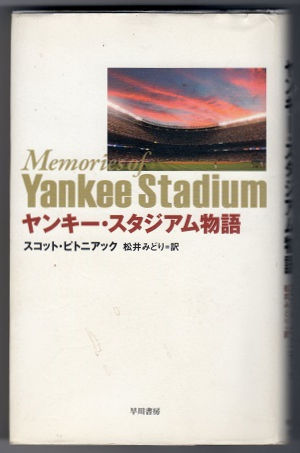
Nowadays, it is an established tradition in every Major League Baseball stadium that when a pitcher has two strikes, fans clap in the hope of striking out the batter, but it could be said that the tradition that began at Yankee Stadium, which was created by Ron Guidry in 1978, was the forerunner of this tradition in every Major League Baseball stadium.
While many of the photographs on display at the Louisiana Sports Hall of Fame are in color, Guidry’s photo was in black and white. I liked that, because somehow I felt that black and white photograph suited Guidry, who was always taciturn, better than color photograph.
( If I’ve made a mistake or left out something important, please let me know. I’ll try to make corrections or additions.)