SLG and ISO of Players with the Highest Batting Averages
In this column, I would like to outline the process and results of my personal analysis regarding the slugging percentage (SLG) and isolated power (ISO) of players who lead the league in batting average.
In 2001, Ichiro moved to the United States as the first Japanese position player in Major League Baseball. At the time, there was considerable debate in both Japan and the U.S. about whether Ichiro could succeed in the majors. Although Ichiro had achieved remarkable success in Japanese professional baseball—leading the league in batting average for seven consecutive years—the overwhelming majority of people believed he wouldn't be able to put up significant numbers in the MLB. However, I consistently voiced an opinion that ran directly counter to that view: "Ichiro is bound to succeed in the majors; he'll win the batting title in his debut season in 2001. The only real question is when he'll break George Sisler's MLB record of 257 hits in a single season."

As it turned out, my prediction was correct. Yet, something happened that I hadn't anticipated at all—though I never voiced it publicly....
During his seven-year run leading the Japanese league in batting average, Ichiro's SLG never once dropped below .500, and he consistently ranked among the top ten in that category. However, after moving to the MLB in 2001, while his batting average of .350 led the American League, his SLG fell to .457—ranking 40th in the league. This was a result I hadn't foreseen in the slightest. I was shocked that Ichiro's SLG had dropped so drastically; it made me keenly aware that the level of play in the MLB is indeed different from that of Japanese professional baseball.
SLG can be said to reflect how hard a batter swings the bat and how powerfully they hit the ball. Consequently, it is fair to say that, unlike during his time in Japan, Ichiro was not hitting the ball with the same level of power in the major leagues. Wondering how other players who led the league in batting average compared, I examined the league rankings for SLG among all players who had topped the league in batting average since the modern era of Major League Baseball began in 1901.
I discovered that Ichiro's ranking of 40th—his position in 2001—tied for the lowest ranking in history for a batting average leader. The player who shared that 40th-place ranking was Willie Wilson, the American League leader in batting average in 1982.
Since learning this result in 2001, I have continued to track the SLG rankings of the league's batting average leaders every year.
In 2004, Ichiro led the American League with a .372 batting average but ranked 42nd in SLG—the lowest ranking ever for a league batting leader.
I plotted the results from 1901 to 2004 on a graph. The horizontal axis represents SLG ranking, and the vertical axis represents the number of players with the highest batting average in the league.

This graph reveals a clear trend: the player ranked first in batting average is most often ranked first in SLG as well, and the number of top-ranked hitters in batting average decreases as the ranking for SLG drops. You can also see that Ichiro's SLG rankings in 2001 and 2004 were exceptionally low.
I have continued this research ever since. Here, I present a graph showing the results from 1901 through last year (2025).
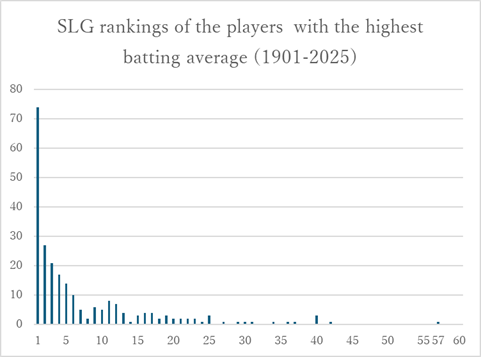
Surprisingly, a player has emerged who leads the league in batting average yet ranks 57th in slugging percentage—a position even lower than the 42nd place held by Ichiro in 2004. That player is Luis Arraez, the 2024 National League batting average leader.
By the way, while conducting this analysis, I noticed someFthing that took me by surprise.
There are batting average leaders who hit zero home runs. You might naturally expect such players to rank extremely low in SLG, but that is not actually the case. Take, for example, the renowned Rod Carew, who led the league in batting average seven times. In 1972, he topped the league in batting average despite hitting zero home runs; yet, he ranked 25th in SLG. When comparing this to Ichiro in 2004 (8 home runs, 42nd in SLG) and Arraez in 2024 (4 home runs, 57th in SLG), I was somewhat surprised to find that Carew's SLG ranking was not particularly low.

Upon learning this, I became genuinely interested in ISO (Isolated Power)—a metric I had previously paid little attention to.
SLG is calculated by dividing total bases by at-bats. Expressed as a formula: (1B + 2B×2 + 3B×3 + HR×4) / AB. In other words, hitting a large number of singles (1B) will result in a reasonably high SLG. This means it does not accurately reflect the ability to hit extra-base hits, such as home runs. ISO, on the other hand, excludes singles and focuses solely on the rate of doubles, triples, and home runs, thereby providing a more accurate measure of a batter's power. The formula is: (2B + 3B×2 + HR×3) / AB.
I examined and graphed the ISO rankings of every player who led their league in batting average from 1901 to 2025.

Players with the highest batting averages most frequently rank at the top in ISO as well. There is a tendency for the number of top-batting-average players to decrease as their ISO ranking drops. However, compared to the graph for SLG rankings, the ISO rankings of top-batting-average players show greater dispersion, with many appearing in lower-ranked positions.
In terms of all-time ISO rankings, the lowest position is 75th (Ichiro, 2004), followed by 69th (Arraez, 2023), 66th (Ichiro, 2001), and 65th (Arraez, 2024). Do you know why Ichiro ended up with the lowest ISO ranking, even though Arraez ranked lowest in SLG? The explanation is simple.
There are two key points. First, since Ichiro had significantly more at-bats than Arraez, the denominator used to calculate ISO is larger for him. Incidentally, Ichiro's 704 at-bats in 2004 and 692 at-bats in 2001 rank first and second all-time among players who led the league in batting average. For more on this, please refer to my column, "The Essence of Ichiro's Batting," published on this website.
Next, while Ichiro has significantly more hits than Arraez, the difference consists entirely of singles; consequently, the numerator used to calculate Ichiro's ISO does not increase.
The combination of these two factors results in Ichiro having a lower ISO—and thus a lower ranking—than Arraez.
Rod Carew ranked 25th in SLG in 1972 but dropped to 46th in ISO. Why wasn't Carew's ISO ranking lower than Ichiro's or Arraez's, given that he hit zero home runs? The primary reason is that Carew had fewer at-bats than either Ichiro or Arraez.
Through these analyses, I believe I have gained a concrete understanding of the difference between SLG and ISO, as well as the relationship of both metrics to batting average.
I also came to appreciate just how unique Ichiro and Arraez are as hitters in the history of Major League Baseball.
(If I've made a mistake or left out something important, please let me know. I'll try to make corrections or additions.)