Yale, Oklahoma : The man known as the world's greatest athlete
Early one morning in early autumn 2013, I was visiting the United States and leisurely driving north on State Route 99 in the Oklahoma countryside, heading for the house of a great man who had lived a turbulent life. After about an hour of driving, I came to a four-way intersection, turned left, and entered State Route 51.
After driving for a while, I came across a large sign announcing that the road had a nickname: Jim Thorpe, the name of the man who lived in the house I was heading for.

Under a cloudless autumn sky, I continued my leisurely drive, taking in the beautiful, green countryside. After driving about 10 kilometers, I arrived in Yale, a small town with a population of about 1,300.
I was able to find the house I was looking for easily, as it was located right off the road that runs through the center of town. However, the door was locked and I couldn't get in. I read the sign in front of the house and it said that people were allowed in from 9:00. There was still 30 minutes to go.

I went around to the back of the house. It was like a small valley, with a beautiful lake at the bottom. I went down to the bottom and stared blankly at the lake.
When I returned to the front of the house at 8:50, an elderly white woman who seemed to be the caretaker was unlocking the door. She noticed me and called out,
"Where are you from?"
"From Japan."
"You've come quite a long way. It's still a little early, but I'll unlock the door and let you in."
I followed the woman into the house where Jim Thorpe lived.
Jim Thorpe, who died in 1953 at the age of 64, is a great man whom I greatly admire. He won two gold medals (in the pentathlon and decathlon) at the Fifth Olympic Games held in Stockholm in 1912. He also played professionally in baseball, American football, and basketball, and played in the Major Leagues for six years. He was called the world's greatest athlete by many.
The house where Thorpe lived was a small, single-story building, so it was hard to call it a fancy house from the outside. But once inside, the impression changed completely. There were quite a few rooms (although they were small), and each room was beautifully furnished. This was a surprise, and it was different from what I had imagined...
Thorpe's parents were of mixed Native American and European descent. Thorpe experienced blatant racism at various points in his life. After retiring from sports, he worked a variety of jobs but lived in poverty. It's said that he was even penniless. So, I had mistakenly assumed that Thorpe had always lived in poverty.

There was another surprise, too. Inside the house, there were a portrait of Thorpe and many photographs showing Thorpe's success as an American football player, but there seemed to be very little about other sports. The only information about his time as a Major League Baseball player is a single photo from 1913, when he joined the New York Giants (now the San Francisco Giants).


There was one other surprise for me: a large poster for the Jim Thorpe biopic starring Burt Lancaster, a film I had never heard of.
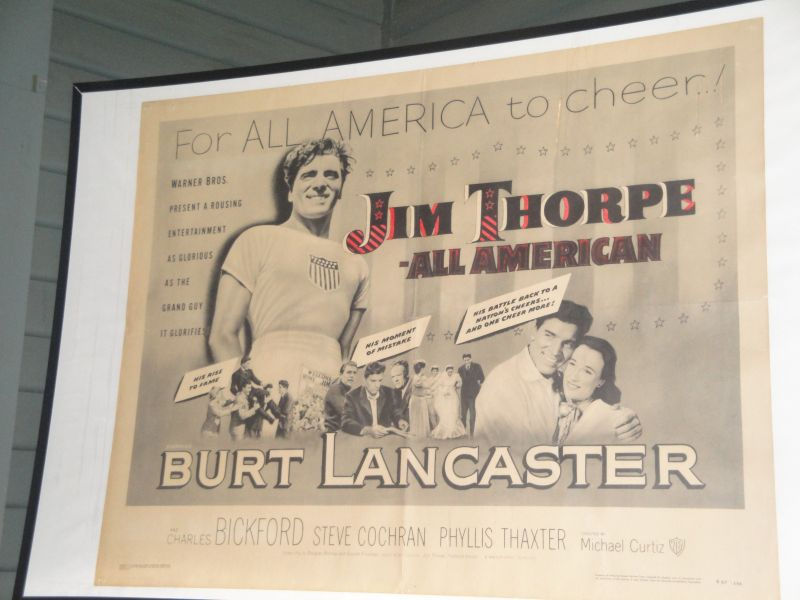
By the way, I was the only tourist there. I was the only one there for two hours. And so, I had the caretaker, an elderly white woman, all to myself for two hours. I'm incredibly strong in situations like this. For some reason, it's the elderly woman I get on with the best.
We had a great conversation, and she told me a lot of information I didn't know before. For example, this house is currently owned and preserved by the Oklahoma Historical Society. Thorpe was born and raised in another city in Oklahoma, but he moved into this house because he had relatives living nearby. He lived in this house from 1917 to 1923, during which time he had children with his first wife (Thorpe was married three times in his lifetime).
There was one thing I really wanted to ask her. It may be something I shouldn't ask, but I had to.
"Was Thorpe's life happy?"
The woman replied immediately.
"He was definitely happy when he lived in this house. He had a great family, and it seems he got along very well with his relatives who lived nearby."
I was relieved.
It was at least comforting that Jim Thorpe, who was known as the world's greatest athlete but suffered severe discrimination and was forced to live in extreme poverty, had once had a happy period.
In 2024, 11 years after my visit, the Oklahoma Historical Society apparently sold the Jim Thorpe house to the Thorpe Family Foundation.
(If I've made a mistake or left out something important, please let me know. I'll try to make corrections or additions.)